
Arts based research

Arts based research methods can be very effective at supporting lesser-heard groups to express nuances of their experiences and how they have made meaning from them. Here are three examples of my work as an artist-researcher on interdisciplinary research projects.
RESPECT – Racialised Experiences Project: Education, Children & Trust

The RESPECT project explored the experiences of racism on 9 to 11 years old, from Black, Asian and minority ethnic communities, and the impact they feel it has on their wellbeing.
Methods
In consultation with the team, drawn from researchers specialising in psychology and education and I designed a body mapping activity to explore how external events can affect us internally. The project created a tool kit to support trainee teachers to have conversations with the children they teach about racism and its impact.

Body mapping to explore the internal impact of external events.
Children’s picture book
However, the children shared their experiences so wholeheartedly we felt we could, and should, do more. So we co-produced a children’s picture book, If Racism Vanished for a Day… with 17 of our participants. The book focusses on themes from the original research participants, with each page imagining how they might feel if racism was not negatively affecting their lives.

Hard copies of the book are available – please get in touch via the contact page, and you can read the digital version here here.
Billboard
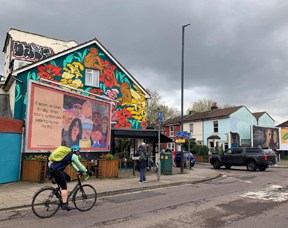
We then worked with AdBlock Bristol to install a billboard created from one of the pages from the book. Adblock’s mission is to reduce city dwellers’ exposure to advertising in public spaces by replacing them with images that speak about solidarity, community and connection. The RESPECT billboard invited passers-by to envisage a future without racism, and amplified children’s voices in a space where they are rarely heard. The billboard was on display in a busy inner city area for three months, and in that time a number of schools across the south west undertook anti-racism lessons in response to it.
Training animation for Avon and Somerset Police
The study revealed a broken relationship between young children and the police, and most recently members of the RESPECT team partnered with Avon and Somerset Police to develop a much-needed resource which is hoped will inform anti-racist practice in this force. The animation presents four real examples of children’s experiences. They consistently expressed how they felt let down by the police, that the police made them feel unsafe, that they were sometimes scared to leave their homes, and how they worried about family members being targeted by police officers.
You can watch the animation here We want to be treated with Respect
Participants’ comments
‘I’ve loved working on this project, It has been really inspirational because I have realized that racism isn’t talked about enough and all that racism is till very prevalent in the modern world.’
‘It was very fun and exciting and it brought me lots of joy. I enjoyed the drawings and being able to express myself through the drawings. I think it’s very good to talk about racism.’
‘I really enjoyed the drawing more than the writing because I got to express myself more. Writing is more complicated’.
‘This project was very fun and I really enjoyed it. My favourite part was the drawing because it’s easier to express my feelings through drawings.’
‘I felt as if I could express what I really want to say without hesitation. Being able to make a book to raise awareness on racism and how it should not be tolerated. Being able to be an illustrator in the book. I could be a part of a great community who raise awareness of racism. Thank U.’
Find out more about RESPECT here.
VIP-CLEAR – Voices in a Pandemic – Children’s Lockdown Experieneces Applied to Recovery
This AHRC-funded research explored how the COVID-19 pandemic restrictions impacted on the learning, development, health and wellbeing of 3 to 11 year olds living in disadvantaged areas of Bristol.
Methods
Taking a creative approach can allow participants to express things in their own way. In consultation with the team, I designed and delivered a range of creative sessions to enable children to express their worldviews, perceptions and experiences during the COVID-19 pandemic, and what their hopes and ambitions were for the future. The sessions aimed to be accessible and enjoyable sessions so that participants had a good time and would stay engaged with the research process over the longer term.

Our processes had to work effectively in and out of different lockdown restrictions and the three phases of creative activity shifted between online and face-to-face, first-hand and second-hand, digital and hard copy. We also engaged staff and parents in some of the creative activities to gain a contextualised view of the children’s experiences. The COVID rules were very restrictive for many children, so it was particularly important that our demands on participants should not feel formal, repetitive or boring, or introduce any additional stress into their lives.

Deep mapping – what does your world look like at the moment?

Photo elicitation – what do these images mean to you and what is missing?

Trees of hope and ambition – what support do you need for these things to happen?
Participants’ comments
‘It was exciting to do more art. It was exciting to do something new in Year 5. It felt important because it’s talking about what we did in lockdown.’
‘It was lots of fun. I liked the bit where we added things to the maps.’
“Luci looked like a normal person but is an artist. Her work is very interesting and made us motivated to do more art.’

Children’s picture book
A subset of the team co-wrote a picture book called Learning to live with Fog Monsters based on our research findings, which I illustrated. It aims to help support children in future social shocks and the story begins with a siren, warning about a risk that you cannot see or hear, but that changes everything – the Fog Monsters. It follows Layla and Arlo as they adjust to this huge upheaval in their lives and discover ways to cope, adapt and and hope.

The images are hand drawn and then coloured digitally. The narrative text is embedded in the images, sometimes taking on the shape of something relevant to the story.

What the young people say:
‘I really liked it because they’re doing something hopeful and not giving up.’
‘I found it intriguing and want to know more.’
Learning to Live with Fog Monsters was Highly Commended, at the Geographical Association Publishers Award 2022. Hard copies of the book are available – please get in touch via the contact page.
You can read the digital version here.
Find out more about VIP:CLEAR here.
HIDDEN WATERWAYS AND DAYLIGHTING
AHRC funded Towards hydrocitizenship. Connecting communities with and through interdependent multiple water issues (2014-2017) took an innovative and multidisciplinary approach to intergenerational arts-based research and my role was engage communities in creative conversations about water.
Methods
I designed and delivered deep mapping sessions with primary school children to explore the potential of daylighting their local rivers, Colliters Brook and the Malago.

Project outputs
Working with groups of older people, I collected their stories about the rivers into a book, which I illustrated.


I made an interactive account of the project that you can visit here.
We presented this work at several conferences, mounted an exhibition, and wrote the following papers:
2020 ‘Reweaving urban water-community relations: creative, participatory river ‘daylighting’ and local hydrocitizenship’ Lindsey McEwen, Luci Gorell Barnes, Iain Biggs and Katherine Phillips in Transactions of the Institute of British Geographers. and a book chapter.
Here is a link to the paper
2019 ‘Voicing waters: (co-)creative reflections on sound, water, conversations and hydrocitizenship’ Owain Jones, Luci Gorell Barnes and Antony Lyons in Doughty, K.; Duffy, M. & Harada, T. (Eds), Elgar.
Here is a link to the book
For a more detailed account of Hidden waterways and daylighting and the three other research strands you can click onto the Water City